High Dependence on Purchased Inputs
Synthetic fertilizers and crop-protection products are recurring, volatile costs — with few on-site alternatives.
Need: Reduce input dependence without losing performance

Plasma-Activated Water for Greenhouses
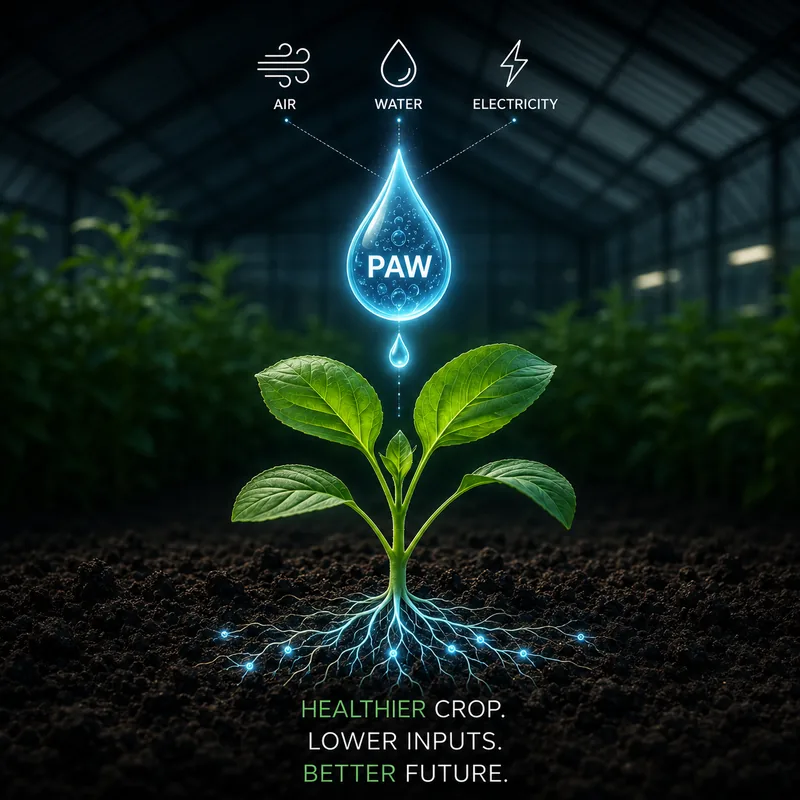
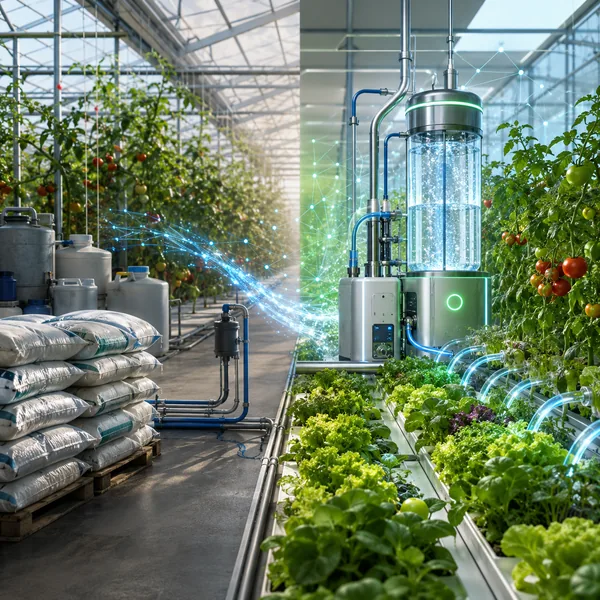
PlasmaCrop generates Plasma-Activated Water at the greenhouse to reduce dependence on synthetic inputs, support crop performance, and enable more responsive treatment strategies.

Working PAW reactor
Built and operating in laboratory conditions

2 crops initially trialed
Tomato and bell pepper

5+ years of plasma-agriculture R&D
Supported by peer-reviewed research
The Challenge
Rising fertilizer costs, disease pressure, and stricter residue rules are squeezing margins — while input programs stay dependent on external chemicals and fixed schedules.
Synthetic fertilizers and crop-protection products are recurring, volatile costs — with few on-site alternatives.
Need: Reduce input dependence without losing performance
Humid greenhouse conditions push up fungal and bacterial pressure, while retailers demand lower residues.
Need: Lower-chemical disease control
Fertigation schedules stay static even as crop needs shift with stage, variety, and climate.
Need: Responsive, condition-aware treatment
The Market Gap
An on-site input system that adapts to real greenhouse conditions — built for growers across Europe.
e.g. Fertilizer prices +8.0% YoY in Q4 2025 (Source: Eurostat, 2026)
Eurostat, 19 May 2026At least 20% reduction in fertilizer use by 2030 (EU Farm to Fork Strategy)
European Commission Farm to Fork StrategyThe Solution
PlasmaCrop generates Plasma-Activated Water on-site and adapts treatment to real crop and greenhouse conditions — reducing chemical inputs and disease pressure, without disrupting existing infrastructure.
Most PAW systems run on fixed settings. PlasmaCrop pairs a greenhouse-ready reactor with a Recipe Engine that adjusts to each crop — within grower-defined limits.

Crop and greenhouse data
Sensors and greenhouse records track crop type, growth stage, and climate.

Crop-specific parameter selection
The Recipe Engine recommends voltage, time, and gas flow for the target crop effect.

On-site PAW generation
The reactor produces PAW on demand, delivered through existing irrigation.
Crop Data → Recipe → PAW Output → Crop Response → Improved Recipe
Once steps 1–2 are built, this is the logic that connects them.
Connects PAW production to existing irrigation infrastructure
Recommendations remain within predefined grower and safety limits
Dashboard, alerts, recipe status, and performance tracking
PlasmaCrop turns fixed input programs into an adaptive system — built for greenhouses across Europe.
Innovation Advantage
PlasmaCrop pairs a validated on-site PAW reactor with a planned AI-driven recipe system — an approach not yet offered by existing PAW providers.
| Source | Static / Fixed Inputs | Dynamic / AI-Driven Inputs |
|---|---|---|
| External Chemical Source | Conventional Fertilizers | Precision Ag Platforms |
| On-Site Generated | PAW Generators (competitors) | PlasmaCrop ⭐ |

Deep plasma-physics foundation
Reactor built on founder's plasma-physics research and Tartu University collaboration, validated on tomato and bell pepper.

Early crop-response data (2 crops)
Initial results across 2 crops linking reactor parameters to outcomes.

Adaptive-recipe approach — first to market
AI-driven, crop-specific approach not yet publicly pursued by established PAW competitors.

Founder expertise as a moat
Rare combination of plasma physics and agricultural application knowledge.
Market Opportunity
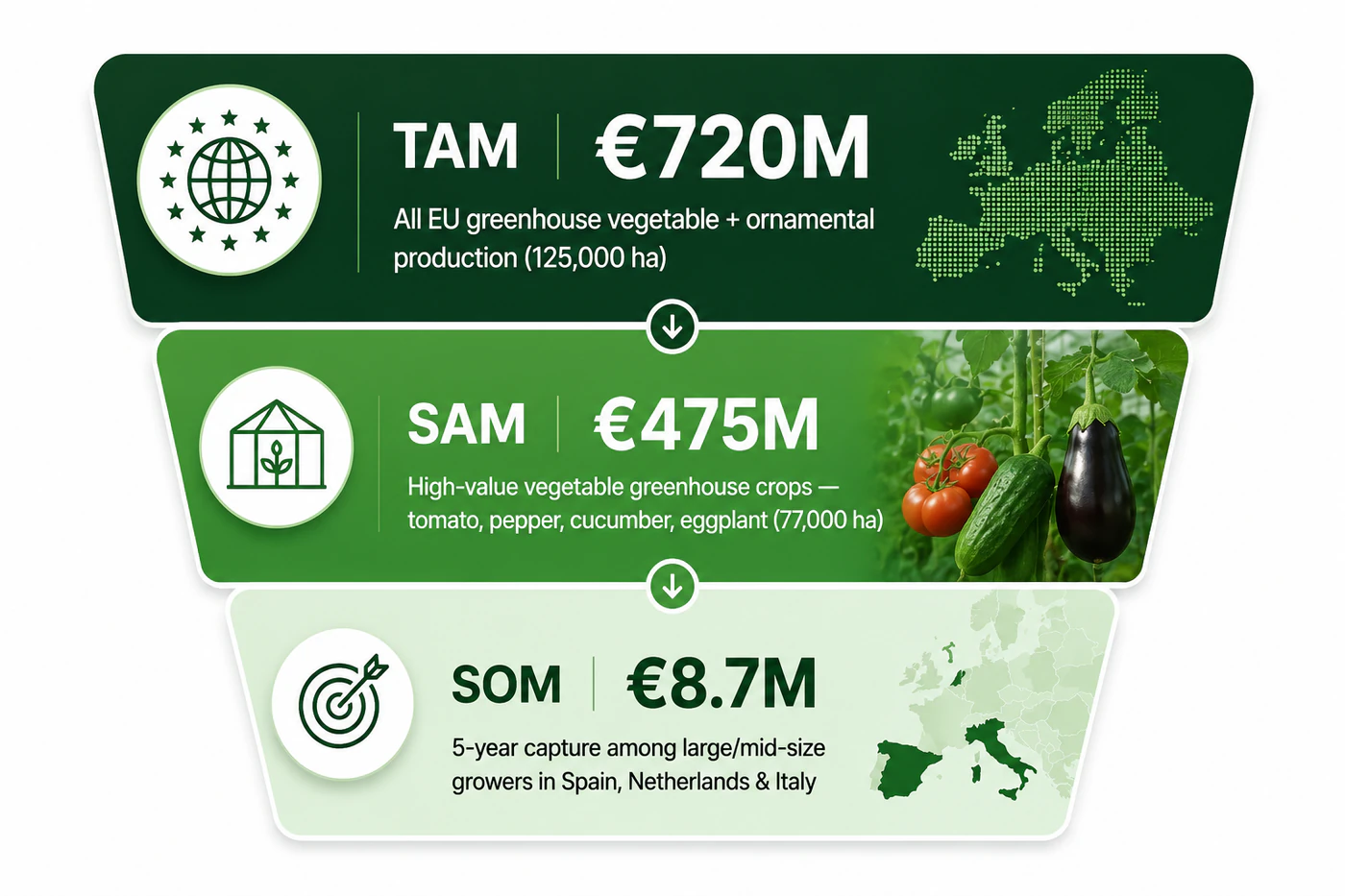
PlasmaCrop starts with high-value vegetable greenhouses, where fertilizer costs and disease pressure hit margins hardest — building evidence for expansion across Europe's largest greenhouse clusters.
Initial Beachhead Market
Initial crops: tomato & bell pepper
Initial customers: Commercial & multi-site growers
Initial pilots: EU greenhouse regions
•2-3
Pilot greenhouses
•1-2
Crop protocols
•5-10 ha
Pilot coverage
•15-20 ha
Year-2 pipeline
Pilot Validation
Greenhouse pilots establish crop response and system reliability.
Regional Expansion
Reference customers extend into neighboring greenhouse markets.
EU Greenhouse Clusters
Partner-led scale-up across Europe's high-value production regions.
Business Model
Revenue starts with hardware and service — expanding into AI-driven recipe subscriptions as the Recipe Engine comes online.
Phase 1 — available at launch
On-site PAW generation hardware

On-site PAW reactors — installed, leased, or site-based.
Phase 1 — available at launch
Reliable operation inside greenhouse workflows

Ongoing support, calibration, water-quality checks.
Phase 2 — once the Recipe Engine is built
Planned recipe engine, dashboard, and optimization
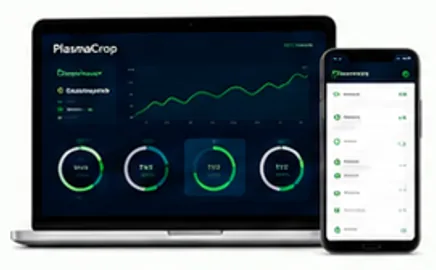
Adaptive, crop-specific optimization from sensor & yield data.
Phase 2 — once the Recipe Engine is built
Validated recipes for additional crops

Validated recipes extended beyond tomato & pepper.
Team
A team combining plasma physics, agronomy, and software — built to take PlasmaCrop from validated lab reactor to greenhouse pilots across Europe.

Plasma Technology Lead
Leads plasma physics, reactor design, and technical validation.

Product & Commercialization Lead
Leads product definition, greenhouse workflow design, and customer discovery.

Entrepreneur & Business Development Lead
Leads partnerships, funding, commercialization, and EU market access.

AI & Software Lead
Builds Recipe Engine logic and greenhouse data modeling.
Plant Biology Lead
Leads crop selection, agronomic testing, and PAW protocol design.

5+ years
Plasma-agriculture R&D

3
plasma configurations evaluated
Multiple crop studies
across growth, stress tolerance, and shelf life
10+
Peer-reviewed publications in the team evidence base
Months 1–4
Team & pilot agreements in place
Months 5–9
PAW protocol validation
Months 10–12
Commercial readiness
Validation & Traction
Reactor development, peer-reviewed plasma chemistry, and internal crop trials form the evidence base behind PlasmaCrop's approach.
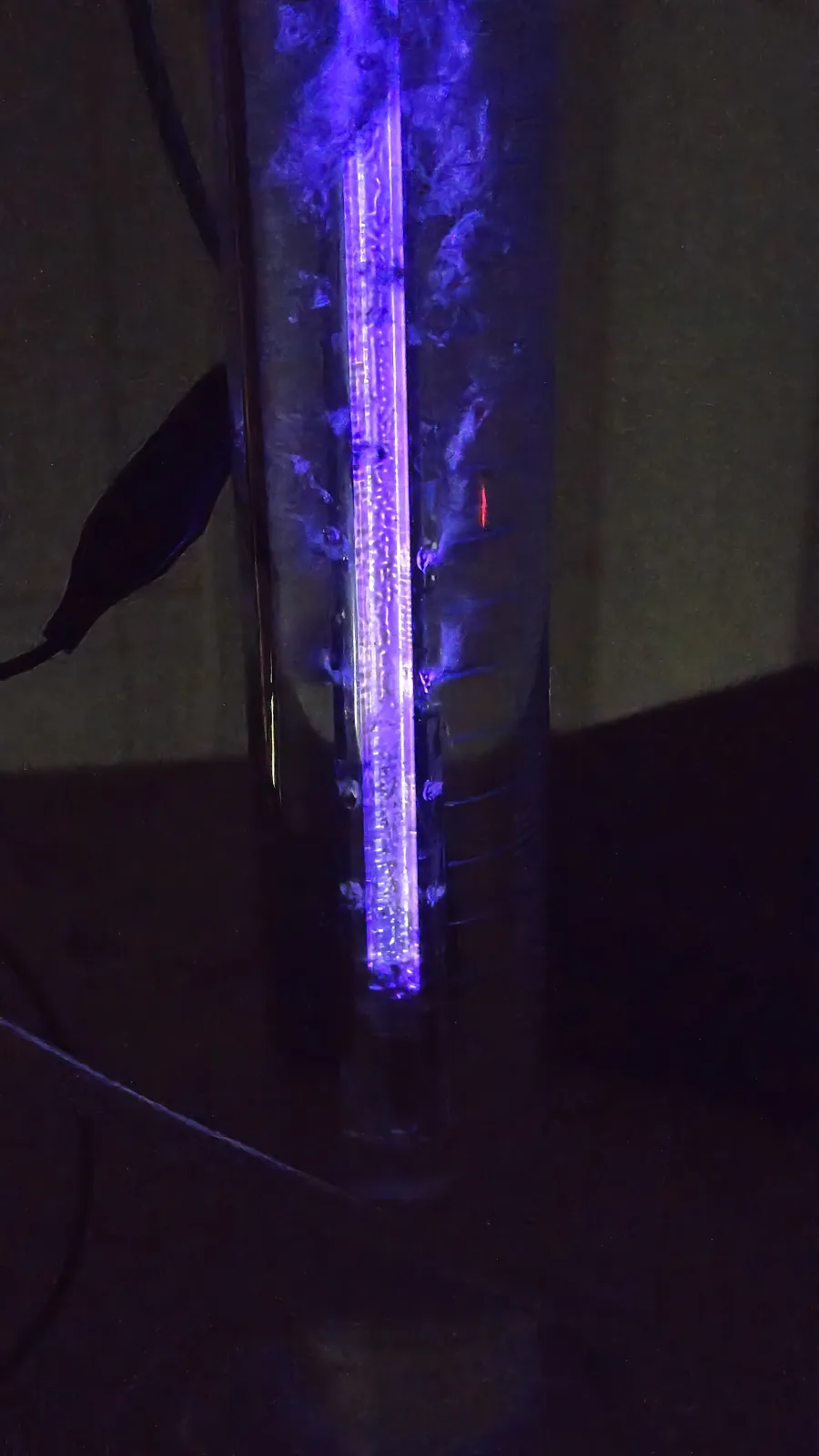
Growth-chamber, unpublished team data
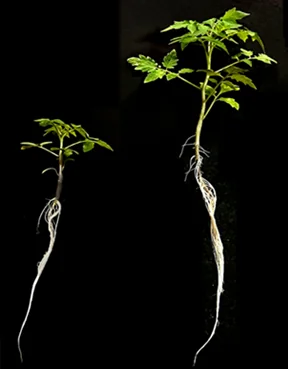
+200%
Leaf Area
+54%
Chlorophyll Content
+30%
Root Length
+86%
Leaf Number
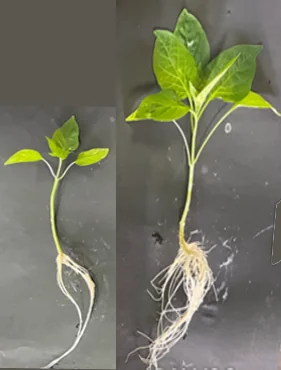
+90%
Leaf Area
+40%
Chlorophyll Content
+30%
Root Length
+78%
Leaf Number
Peer-reviewed publications
Next Validation Step
Moving from growth-chamber trials to greenhouse pilots across Europe.
PlasmaCrop is seeking greenhouse partners across Europe to pilot adaptive PAW treatment — validating crop response, input reduction, and system reliability.
Growing tomatoes or bell peppers in a European greenhouse? Tell us about your operation and current input program.